
The Office of Sheriff
The essential requirement for the role of a sheriff is to possess the ability and legal standing to perform the functions of the office.
This requires knowledge and experience of civil law and practice and that relating to summary and solemn crime. A sheriff with limited experience in any particular area of the law will have demonstrated their ability to acquire that knowledge and will be expected to sit in judgment thereafter.
The primary function of the sheriff is to act as judge at first instance and to issue oral and written decisions, often quickly and under pressure.
Sheriffs have jurisdiction to deal with some appellate, administrative and quasi-judicial functions and may conduct Fatal Accident Inquiries. Some sheriffs are designated as specialists in areas such as family and commercial work or solemn criminal work. Others are appointed to sit in the All Scotland Personal Injury Court. Those with five or more years’ service, may be appointed as appeal sheriffs to sit in the Sheriff Appeal Court. Sheriffs may be asked to sit as temporary judges in the High Court.
Each sheriff in Scotland has the same powers and responsibilities throughout Scotland. In the cities and larger towns, a number of sheriffs and summary sheriffs may work in the same building. In some courts there may be only one sheriff. In some sheriffdoms, especially in the more rural areas, particularly those on the islands, the sheriff may sit in more than one court building during the course of a week.
Eligibility
Eligibility for the office of sheriff is set out in Section 14 of the Courts Reform (Scotland) Act 2014 which states that immediately before appointment you must:
- hold any other judicial office specified in Section 14, or
- be legally qualified (either as a solicitor or advocate) for a period of ten years.
Skills and Qualities
The skills expected of sheriffs include an active management of cases to ensure the efficient disposal of court business, versatility, the ability to deal with any case and at short notice, and the ability to work in an atmosphere of collegiality with fellow sheriffs. In some courts, sheriffs preside over problem solving courts. In all courts, sheriffs are expected to take, where appropriate, a problem solving approach. In some cases, a sheriff is required to engage with parties and agents to seek to resolve disputes by mediation or another form of alternative dispute resolution. Sheriffs’ deal with a large number of unrepresented parties in both civil and criminal courts. They may be asked to consider a triage approach to help inform and guide individuals in identifying the most appropriate route to resolving their problem.
Any judicial post holder must in addition possess a range of personal and judicial qualities in order to successfully perform the functions of the office. You can find out more about these by reading the Role Profile, created by Judicial Office for Scotland.
What Are We Looking For
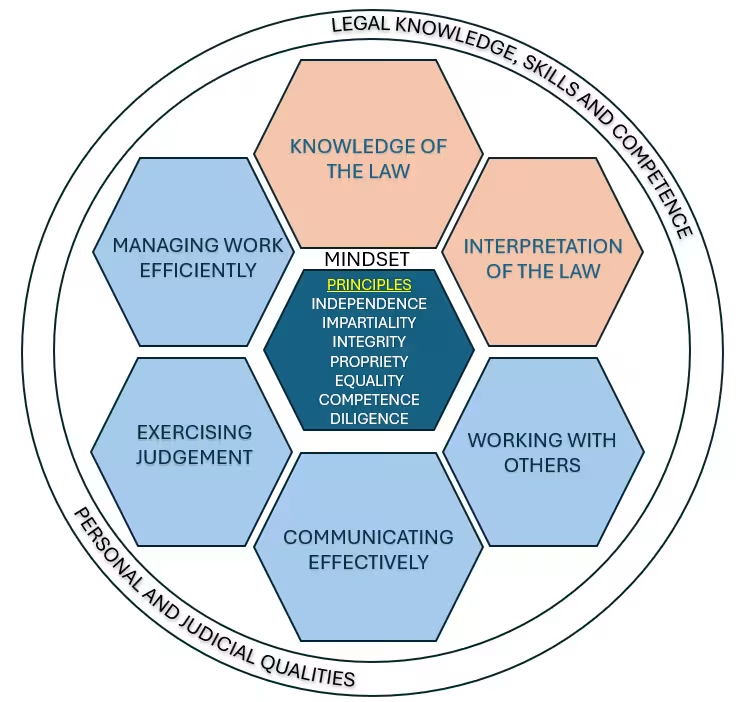
Successful candidates will be required to demonstrate:
- The ability and legal standing to perform the functions of the office of sheriff. This requires knowledge and experience not only of civil law and practice but also of summary and solemn criminal law. Candidates who do not have knowledge or experience in each of these disciplines must demonstrate the ability to acquire knowledge in unfamiliar areas of the law.
- Excellent decision-making skills, with the ability to make clear and timeous decisions on complex and challenging cases, and to manage cases and overall caseload effectively and efficiently.
- The ability to produce clear, accessible, and sound written judgments in a timely manner.
- The ability to work collegiately with fellow sheriffs and judicial colleagues and contribute to the effective administration of the courts.
- Diligence and a commitment to upholding the rule of law and enhancing the standing of the courts.
- Resilience in making judgments on complex and challenging matters in a demanding operating environment.
- The ability to communicate clearly and effectively with others, including parties, agents, and court users.
- It would be desirable to have experience of appearing in the sheriff court.

Knowledge of the Law
- A high level of expertise in the applicant’s area of practice
- Good working knowledge of at least one other area of substantive law commonly encountered in the Sheriff Court or evidence of motivation and ability to acquire sufficient knowledge
- Good working knowledge of the law of evidence
- Knowledge of the principles of natural justice and Sheriff Court practice and procedure, including the conduct of jury trials
Skills and Competence in the Interpretation and Application of the Law
- Ability to analyse complex legal problems and apply the law correctly
- Ability to analyse and interpret case law and statute
- Ability to apply the law in unfamiliar areas
Managing Work Effectively
- Manages cases and time effectively
- Is diligent and hard-working
- Is confident in managing the court/hearing process
- Is able to deliver work at speed and under pressure
Communicating Effectively
- Establishes authority and inspires respect and confidence
- Modifies communication style to meet the needs of different court users
- Listens with patience and respect
- Produces written work that is clear, concise and well-reasoned
Exercising Judgement
- Remains impartial and open minded and is seen to be fair to all
- Is able to analyse and assess complex evidence and arguments
- Is able to reason clearly
- Is confident in judging and making independent decisions in the face of challenge
Working With Others
- Understands people and society
- Allows people to give of their best
- Is even-tempered and consistent
- Treats people with respect and sensitivity
Mind-set
- Shows an understanding of and commitment to the role and to public service
- Is self-aware and uses feedback and self-reflection to develop
Other Work Done by Sheriffs
Sheriffs undertake a variety of work in chambers, including:
- Writing civil judgments and parole board reports;
- Preparing stated cases and reports for criminal or civil appeals or children’s referral cases;
- Dealing with warrant requests;
- Dealing with interlocutory matters;
- Considering applications for adoptions and permanence orders, undefended divorces, adult welfare and guardianship orders; and
- Considering reports of breaches of community disposals.
Sheriffs are expected, and are frequently called upon, to serve, and in some instances are required by statute to be represented, on a wide variety of quasi-judicial, administrative and advisory or consultative bodies.
These include-
- The Judicial Appointments Board for Scotland
- The Scottish Civil Justice Council and/or its committees
- The Scottish Sentencing Council and/or its committees
- The Parole Board for Scotland
- The Board of the Scottish Courts and Tribunals Service
- The Advisory Council Committee of the Judicial Institute
- Working groups and sub-committees for the Judicial Council
- The Scottish Legal Aid Board
- The Justices of the Peace Training Committee of the Judicial Institute
- Court user groups
- Criminal justice bodies
- Research groups