
Structure of the Judiciary in Scotland
The Judicial Appointments Board for Scotland (JABS) recommends people to judicial offices in Scotland. But what are those offices, and how do they all fit together?
Scotland’s legal system traces its roots back to medieval times, having developed independently from English law. The system today is based on a mixture of common law, statutory law, and civil law influences. Central to this system are the courts and tribunals, where disputes are resolved and justice is dispensed.
As a consequence of this independence, Scotland’s system of courts and tribunals is distinct from that of the rest of the United Kingdom, If you’re unfamiliar with how these courts and tribunals are structured this guide will explain.
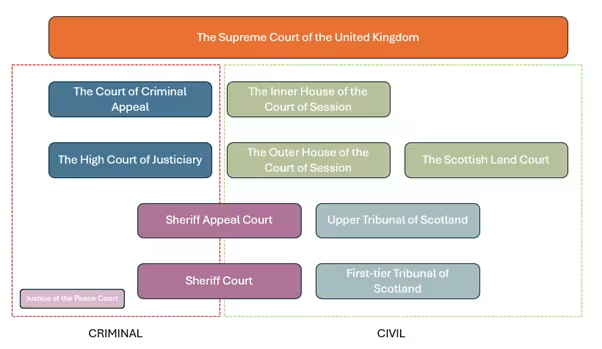
At the highest level, there are two main branches – courts and tribunals. Courts deal with a mix of civil and criminal matters, tribunals deal solely with civil.
The head of the judiciary in Scotland is the Lord President. He is the most senior judge in Scotland and has authority over any court established under Scots law other than the Court of the Lord Lyon (the court which deals with armorial matters in Scotland). The Lord President has a deputy, the Lord Justice Clerk. Both the Lord President and Lord Justice Clerk also sit as members of His Majesty’s Most Honourable Privy Council, as does the President of Tribunals.
Courts
The senior courts in Scotland are the High Court of Justiciary (“the High Court”), which deals with serious criminal matters and the Court of Session (including the Scottish Land Court) which deals with serious civil cases. Both of these courts have an appellate court – the Court of Criminal Appeal and the Inner House of the Court of Session respectively, with any final appeals being heard by the Supreme Court of the United Kingdom.
The Bench for both the High Court and the Court of Session is comprised of Senators of the College of Justice. Limited to a fixed maximum of 36, these are the judges given responsibility for hearing these most serious cases. Senators of the College of Justice are granted judicial titles and will sit as the Honourable (or in some cases, the Right Honourable) Lord or Lady.
Sitting below the senior courts are the sheriff courts. Sheriff courts deal with both criminal and civil business which does not meet the threshold of severity for the senior courts, although business can be referred from sheriff courts to the senior courts if required. Both Sheriffs (who can deal with summary and solemn work) and Summary Sheriffs (who can only deal with summary work) can sit in a sheriff court.
Sheriff courts are organised into six sheriffdoms, each led by a Sheriff Principal. These are:
- Grampian, Highland and Islands
- Tayside, Central and Fife
- Lothian and Borders
- South Strathclyde, Dumfries and Galloway
- North Strathclyde
- Glasgow and Strathkelvin
In a sheriff court, solemn procedure is used for serious criminal cases which are prosecuted on indictment before a judge (the sheriff) and a jury of 15. The maximum penalty which may be imposed where solemn procedure is used is imprisonment for a maximum of five years or an unlimited fine.
Summary procedure is used for cases, both criminal and civil, which are not serious enough for solemn procedure, and are heard by a (summary) sheriff sitting alone in a bench trial. The maximum penalty which may be imposed following a summary trial is 12 months imprisonment or a fine of up to £10,000.
The decision whether to try a case as solemn or summary is made by the Crown Office and Procurator Fiscal Service.
Appeals arising from the sheriff courts are heard by the Sheriff Appeal Court.
Tribunals
The Tribunals (Scotland) Act 2014 established the Upper Tribunal and the First-tier Tribunal for Scotland. The Scottish Tribunals are lead by The Right Honourable Lady Wise in her capacity as President of Tribunals.
The First-tier Tribunal is organised into chambers which deal with cases being heard for the first time, called first-instance cases. What the cases involve depends on the chamber in question. There are currently six devolved chambers in the First-tier Tribunal each led by a Chamber President:
- Housing and Property Chamber
- This Chamber deals with appeals by landlords against determinations of the Rent Officer, applications for rent determinations from tenants holding Assured tenancies, applications for determinations of terms made by landlords or tenants following the creation of an Assured tenancy as well as determining applications from homeowners in relation to disputes with their property factor in relation the factors’ statutory duties. It also hears civil cases relating to the private rented sector previously heard at a sheriff court.
- Health and Education Chamber
- This Chamber hears appeals from parents and young people against education authorities relating to the provision of educational support.
- Tax Chamber
- The Tax Chamber hears appeals relating to the devolved Scottish taxes administered by Revenue Scotland.
- Social Security Chamber
- This Chamber hears appeals in relation to social security benefits which are awarded by Social Security Scotland.
- Local Taxation Chamber
- Separate to the Tax Chamber the Local Taxation Chamber or LTC hears appeals which are made in relation to council tax and non-domestic rates in Scotland.
- General Regulatory Chamber
- This Chamber hears appeals against decisions made by the Office of the Scottish Charity Regulator, against the issuing of parking penalty charge notices and against the issuing of bus lane penalty charge notices and, from June 2023 against penalty charge notices issued relating to the new Low Emission Zones .
Each chamber will comprise a number of Members. These generally comprise Legal Members and Ordinary Members, the Ordinary Members usually having specialist skills of knowledge relevant to the Chamber they represent.
The Upper Tribunal is organized into a number of divisions and primarily hears appeals arising from decisions of the First-tier Tribunal, but can hear cases at first-instance if the matters are serious or complex. Each division of the Upper Tribunal has at least one Vice President and decisions of the Upper Tribunal can be made by members sitting in panels of one, two or three. .