
First-tier and Upper Tribunals of Scotland
Tribunals are a central part of the Scottish justice system and play a vital role in the delivery of justice. Tribunals are specialist bodies which are made up of legal and non-legal judicial office holders with expertise and experience in their particular jurisdictions. Children and young people (where permitted) and adults can raise an action with a Tribunal if they want to challenge a decision that affects them. Tribunals can be flexible in their proceedings and where practicable they will be less formal than the courts. Tribunal hearings are conducted across Scotland in different venues, some of which are tailored to a particular type of party’s needs, e.g. sensory hearing suites for children and young people. They are not conducted in court rooms.
The Scottish Tribunals deal with matters that are devolved to the Scottish Parliament. The JABS makes recommendations for the appointment of judicial office holders to the Scottish Tribunals.
The Scottish Tribunals
The Tribunals (Scotland) Act 2014 ('the 2014 Act') created a statutory framework for the Tribunals in Scotland. The Act created two new Tribunals, the First-tier Tribunal for Scotland and the Upper Tribunal for Scotland, known collectively as the Scottish Tribunals. The First-tier Tribunal consists of a number of Chambers, each with its own jurisdiction(s) and headed by a Chamber President.
The First-tier Tribunal for Scotland deals with first instance decisions. These are cases heard at a Tribunal for the first time. Appeals from the First-tier Tribunal are heard in the Upper Tribunal. In certain circumstances, some matters can be appealed from the Upper Tribunal to the Court of Session.
The 2014 Act brings Scottish Tribunal appointments under the remit of the JABS. The structure of the tribunal service in Scotland is shown as follows-
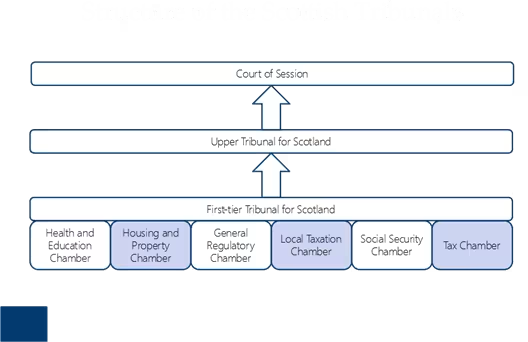
This note sets out the roles and experience required for each of these chambers of the first tier tribunals, setting out the skills required both for legal members and specialist members. Specialist members are sometime described as ordinary members, but as can be seen in the descriptions on each Chamber's dedicated page, their specialisms and specialist knowledge are vital to the effective operation of the chambers.
Common characteristics
All judicial officer holders in the First-tier Tribunal for Scotland will require-
- To demonstrate collegiality.
- To prepare for hearings through careful examination and consideration of all case.
- To analyse written and oral evidence, legal arguments, summarise issues, and apply knowledge to arrive at well-reasoned and balanced decisions.
- To engage in judicial proceedings, ensuring proceedings are effectively and efficiently managed whilst discharging the Tribunal’s overriding objective.
- To manage cases actively and expeditiously, and produce or contribute to a high quality of written work.
- To be courteous and considerate to all parties, witnesses, hearing attendees and staff of the Scottish Courts and Tribunals Service and be sensitive to diverse needs.
- To ensure that decisions, directions and any orders of the tribunal are made efficiently, effectively and without delay.
- To maintain up to date knowledge of the relevant law in their Chamber, and Chamber, practice and procedures.
- Ensure that parties who are not represented are supported to present their case consistent with the Tribunal’s overriding objective.
- Conduct tribunal hearings remotely (online or telephone), in-person or a hybrid version of these. When sitting in-person or on a hybrid basis, travel throughout Scotland, as required.